Cognitive Robotics – Formula Sheet
1. Probability Theory
Conditional Probability
p ( x ∣ y ) = p ( x , y ) p ( y ) p(x \mid y) = \frac{p(x,y)}{p(y)} p ( x ∣ y ) = p ( y ) p ( x , y ) p ( x , y ) = p ( x ∣ y ) p ( y ) p(x,y) = p(x \mid y)p(y) p ( x , y ) = p ( x ∣ y ) p ( y ) Law of Total Probability
Discrete:
p ( x ) = ∑ y p ( x ∣ y ) p ( y ) p(x) = \sum_y p(x \mid y)p(y) p ( x ) = y ∑ p ( x ∣ y ) p ( y ) Continuous:
p ( x ) = ∫ p ( x ∣ y ) p ( y ) , d y p(x) = \int p(x \mid y)p(y),dy p ( x ) = ∫ p ( x ∣ y ) p ( y ) , d y Bayes' Rule
p ( x ∣ y ) = p ( y ∣ x ) p ( x ) p ( y ) p(x \mid y) = \frac{p(y \mid x)p(x)}{p(y)} p ( x ∣ y ) = p ( y ) p ( y ∣ x ) p ( x ) p ( x ∣ y ) = η ⋅ p ( y ∣ x ) p ( x ) p(x \mid y) = \eta \cdot p(y \mid x)p(x) p ( x ∣ y ) = η ⋅ p ( y ∣ x ) p ( x ) Complement Rule
p ( ¬ A ) = 1 − p ( A ) p(\neg A) = 1 - p(A) p ( ¬ A ) = 1 − p ( A ) Entropy
How uncertain are we about a random variable X?
(The entries of X can be a discrete set of states/ a distribution over states. A distribution (kitchen, bedrrom, hallway)=(1, 0, 0) has low entropy, while a distribution (0.33, 0.33, 0.34) has high entropy)
H ( X ) = − ∑ x p ( x ) log p ( x ) H(X) = -\sum_x p(x)\log p(x) H ( X ) = − x ∑ p ( x ) log p ( x ) 2. Gaussian Distributions
Univariate Gaussian
N ( x ; μ , σ 2 ) = 1 2 π σ 2 exp ( − ( x − μ ) 2 2 σ 2 ) \mathcal{N}(x;\mu,\sigma^2)
=
\frac{1}{\sqrt{2\pi\sigma^2}}
\exp\left(
-\frac{(x-\mu)^2}{2\sigma^2}
\right) N ( x ; μ , σ 2 ) = 2 π σ 2 1 exp ( − 2 σ 2 ( x − μ ) 2 ) Multivariate Gaussian
N ( x ; μ , Σ ) = 1 ( 2 π ) n ∣ Σ ∣ exp ( − 1 2 ( x − μ ) T Σ − 1 ( x − μ ) ) \mathcal{N}(x;\mu,\Sigma)
=
\frac{1}{\sqrt{(2\pi)^n |\Sigma|}}
\exp\left(
-\frac{1}{2}(x-\mu)^T \Sigma^{-1}(x-\mu)
\right) N ( x ; μ , Σ ) = ( 2 π ) n ∣Σ∣ 1 exp ( − 2 1 ( x − μ ) T Σ − 1 ( x − μ ) ) Linear Transformation
x ′ = A x + b x' = A x + b x ′ = A x + b μ ′ = A μ + b \mu' = A\mu + b μ ′ = A μ + b Σ ′ = A Σ A T \Sigma' = A\Sigma A^T Σ ′ = A Σ A T 3. Bayes Filter
Belief Definition
B e l ( x t ) = p ( x t ∣ z 1 : t , u 1 : t ) Bel(x_t) = p(x_t \mid z_{1:t}, u_{1:t}) B e l ( x t ) = p ( x t ∣ z 1 : t , u 1 : t ) Markov Assumptions
p ( x t ∣ x 0 : t − 1 , u 1 : t ) = p ( x t ∣ x t − 1 , u t ) p(x_t \mid x_{0:t-1}, u_{1:t}) = p(x_t \mid x_{t-1}, u_t) p ( x t ∣ x 0 : t − 1 , u 1 : t ) = p ( x t ∣ x t − 1 , u t ) p ( z t ∣ x 0 : t , z 1 : t − 1 , u 1 : t ) = p ( z t ∣ x t ) p(z_t \mid x_{0:t}, z_{1:t-1}, u_{1:t}) = p(z_t \mid x_t) p ( z t ∣ x 0 : t , z 1 : t − 1 , u 1 : t ) = p ( z t ∣ x t ) Recursive Bayes Filter
B e l ( x t ) = η p ( z t ∣ x t ) ∫ p ( x t ∣ u t , x t − 1 ) B e l ( x t − 1 ) d x t − 1 Bel(x_t)
=
\eta p(z_t \mid x_t)
\int
p(x_t \mid u_t, x_{t-1})
Bel(x_{t-1}) dx_{t-1} B e l ( x t ) = η p ( z t ∣ x t ) ∫ p ( x t ∣ u t , x t − 1 ) B e l ( x t − 1 ) d x t − 1 η = 1 p ( z t ∣ z 1 : t − 1 , u 1 : t ) \eta = \frac{1}{p(z_t \mid z_{1:t-1}, u_{1:t})} η = p ( z t ∣ z 1 : t − 1 , u 1 : t ) 1 Prediction
B e l ‾ ( x t ) = ∫ p ( x t ∣ u t , x t − 1 ) B e l ( x t − 1 ) d x t − 1 \overline{Bel}(x_t)
=
\int
p(x_t \mid u_t, x_{t-1})
Bel(x_{t-1})
dx_{t-1} B e l ( x t ) = ∫ p ( x t ∣ u t , x t − 1 ) B e l ( x t − 1 ) d x t − 1 Correction
B e l ( x t ) = η p ( z t ∣ x t ) B e l ‾ ( x t ) Bel(x_t)
=
\eta p(z_t \mid x_t)\overline{Bel}(x_t) B e l ( x t ) = η p ( z t ∣ x t ) B e l ( x t ) 4. Kalman Filter
Linear System Model
x t = A x t − 1 + B u t + ϵ t x_t = A x_{t-1} + B u_t + \epsilon_t x t = A x t − 1 + B u t + ϵ t ϵ t ∼ N ( 0 , R ) \epsilon_t \sim \mathcal{N}(0,R) ϵ t ∼ N ( 0 , R ) R: motion noise covariance
Measurement Model
z t = C x t + δ t z_t = C x_t + \delta_t z t = C x t + δ t δ t ∼ N ( 0 , Q ) \delta_t \sim \mathcal{N}(0,Q) δ t ∼ N ( 0 , Q ) Q: measurement noise covariance
Prediction
x ˉ t = A t x t − 1 + B t u t \bar{x}_t = A_t x_{t-1} + B_t u_t x ˉ t = A t x t − 1 + B t u t Σ ˉ t = A t Σ t − 1 A t T + R \bar{\Sigma}_t = A_t \Sigma_{t-1} A_t^T + R Σ ˉ t = A t Σ t − 1 A t T + R Kalman Gain
K t = Σ ˉ t C t T ( C t Σ ˉ t C t T + Q ) − 1 K_t =
\bar{\Sigma}_t C_t^T
\left(
C_t \bar{\Sigma}_t C_t^T + Q
\right)^{-1} K t = Σ ˉ t C t T ( C t Σ ˉ t C t T + Q ) − 1 Correction
x t = x ˉ t + K t ( z t − C t x ˉ t ) x_t = \bar{x}_t + K_t (z_t - C_t\bar{x}_t) x t = x ˉ t + K t ( z t − C t x ˉ t ) Σ t = ( I − K t C t ) Σ ˉ t \Sigma_t = (I - K_t C_t)\bar{\Sigma}_t Σ t = ( I − K t C t ) Σ ˉ t 1D Kalman Filter
Prediction: The mean is transformed linearly and the variances add up.
μ 1 = μ 0 + u \mu_1 = \mu_0 + u μ 1 = μ 0 + u σ 1 2 = σ 0 2 + σ u 2 σ 1 = σ 0 2 + σ u 2 \sigma_1^2 = \sigma_0^2 + \sigma_u^2 \quad \quad \quad \sigma_1 = \sqrt{\sigma_0^2 + \sigma_u^2} σ 1 2 = σ 0 2 + σ u 2 σ 1 = σ 0 2 + σ u 2 Correction: The Kalman gain is the ratio of the variance of the prediction to the total variance (prediction + measurement). The innovation z − μ 1 z-\mu_1 z − μ 1
K = σ 1 2 σ 1 2 + σ z 2 K = \frac{\sigma_1^2}{\sigma_1^2 + \sigma_z^2} K = σ 1 2 + σ z 2 σ 1 2 μ = μ 1 + K ( z − μ 1 ) \mu = \mu_1 + K (z-\mu_1) μ = μ 1 + K ( z − μ 1 ) σ 2 = ( 1 − K ) σ 1 2 \sigma^2 = (1-K)\sigma_1^2 σ 2 = ( 1 − K ) σ 1 2 5. Extended Kalman Filter (EKF)
Nonlinear Models
x t = g ( u t , x t − 1 ) + ϵ t x_t = g(u_t, x_{t-1}) + \epsilon_t x t = g ( u t , x t − 1 ) + ϵ t z t = h ( x t ) + δ t z_t = h(x_t) + \delta_t z t = h ( x t ) + δ t Jacobians
G t = ∂ g ( u t , x ) ∂ x ∣ x = μ t − 1 G_t = \frac{\partial g(u_t, x)}{\partial x}\Big|_{x=\mu_{t-1}} G t = ∂ x ∂ g ( u t , x ) x = μ t − 1 H t = ∂ h ( x ) ∂ x ∣ x = μ ˉ t H_t = \frac{\partial h(x)}{\partial x}\Big|_{x=\bar{\mu}_t} H t = ∂ x ∂ h ( x ) x = μ ˉ t EKF Prediction
μ ˉ t = g ( u t , μ t − 1 ) \bar{\mu}_t = g(u_t, \mu_{t-1}) μ ˉ t = g ( u t , μ t − 1 ) Σ ˉ t = G t Σ t − 1 G t T + R \bar{\Sigma}_t = G_t \Sigma_{t-1} G_t^T + R Σ ˉ t = G t Σ t − 1 G t T + R EKF Correction
K t = Σ ˉ t H t T ( H t Σ ˉ t H t T + Q ) − 1 K_t =
\bar{\Sigma}_t H_t^T
(H_t \bar{\Sigma}_t H_t^T + Q)^{-1} K t = Σ ˉ t H t T ( H t Σ ˉ t H t T + Q ) − 1 μ t = μ ˉ t + K t ( z t − h ( μ ˉ t ) ) \mu_t = \bar{\mu}_t + K_t (z_t - h(\bar{\mu}_t)) μ t = μ ˉ t + K t ( z t − h ( μ ˉ t )) Σ t = ( I − K t H t ) Σ ˉ t \Sigma_t = (I - K_t H_t)\bar{\Sigma}_t Σ t = ( I − K t H t ) Σ ˉ t 6. Unscented Kalman Filter (UKF)
TODO weights
Sigma Points
χ 0 = μ \chi_0 = \mu χ 0 = μ χ i = μ + ( ( n + λ ) Σ ) i \chi_i = \mu + (\sqrt{(n+\lambda)\Sigma})_i χ i = μ + ( ( n + λ ) Σ ) i χ i + n = μ − ( ( n + λ ) Σ ) i \chi_{i+n} = \mu - (\sqrt{(n+\lambda)\Sigma})_i χ i + n = μ − ( ( n + λ ) Σ ) i λ = α 2 ( n + κ ) − n \lambda = \alpha^2(n+\kappa) - n λ = α 2 ( n + κ ) − n Mean
μ = ∑ i w i ( m ) χ i \mu = \sum_i w_i^{(m)} \chi_i μ = i ∑ w i ( m ) χ i Covariance
Σ = ∑ i w i ( c ) ( χ i − μ ) ( χ i − μ ) T \Sigma = \sum_i w_i^{(c)}(\chi_i - \mu)(\chi_i - \mu)^T Σ = i ∑ w i ( c ) ( χ i − μ ) ( χ i − μ ) T 7. Particle Filter
Importance Weight (General)
w t ( i ) ∝ p ( z t ∣ x t ( i ) ) p ( x t ( i ) ∣ u t , x t − 1 ( i ) ) q ( x t ( i ) ∣ x t − 1 ( i ) , u t , z t ) w_t^{(i)} \propto
\frac{
p(z_t \mid x_t^{(i)})
p(x_t^{(i)} \mid u_t, x_{t-1}^{(i)})
}{
q(x_t^{(i)} \mid x_{t-1}^{(i)},u_t,z_t)
} w t ( i ) ∝ q ( x t ( i ) ∣ x t − 1 ( i ) , u t , z t ) p ( z t ∣ x t ( i ) ) p ( x t ( i ) ∣ u t , x t − 1 ( i ) ) or recursively:
w t ( i ) = w t − 1 ( i ) p ( z t ∣ x t ( i ) ) p ( x t ( i ) ∣ u t , x t − 1 ( i ) ) q ( x t ( i ) ∣ x t − 1 ( i ) , u t , z t ) w_t^{(i)}
= w_{t-1}^{(i)}
\frac{
p(z_t \mid x_t^{(i)})
p(x_t^{(i)} \mid u_t, x_{t-1}^{(i)})
}{
q(x_t^{(i)} \mid x_{t-1}^{(i)},u_t,z_t)
} w t ( i ) = w t − 1 ( i ) q ( x t ( i ) ∣ x t − 1 ( i ) , u t , z t ) p ( z t ∣ x t ( i ) ) p ( x t ( i ) ∣ u t , x t − 1 ( i ) ) Bootstrap Filter
w t ( i ) ∝ p ( z t ∣ x t ( i ) ) w_t^{(i)} \propto p(z_t \mid x_t^{(i)}) w t ( i ) ∝ p ( z t ∣ x t ( i ) ) Normalization
w t ( i ) = w t ( i ) ∑ j w t ( j ) w_t^{(i)} =
\frac{w_t^{(i)}}{\sum_j w_t^{(j)}} w t ( i ) = ∑ j w t ( j ) w t ( i ) Effective Sample Size
N eff = 1 ∑ i ( w t ( i ) ) 2 N_{\text{eff}} =
\frac{1}{\sum_i (w_t^{(i)})^2} N eff = ∑ i ( w t ( i ) ) 2 1 8. Differential Drive & Motion Models
Wheel Velocities
v = v r + v l 2 v = \frac{v_r + v_l}{2} v = 2 v r + v l ω = v r − v l L \omega = \frac{v_r - v_l}{L} ω = L v r − v l Instantaneous Turning Radius
R = v ω R = \frac{v}{\omega} R = ω v Velocity Motion Model
x ′ = x − v ω sin θ + v ω sin ( θ + ω Δ t ) x' = x - \frac{v}{\omega}\sin\theta
+ \frac{v}{\omega}\sin(\theta + \omega \Delta t) x ′ = x − ω v sin θ + ω v sin ( θ + ω Δ t ) y ′ = y + v ω cos θ − v ω cos ( θ + ω Δ t ) y' = y + \frac{v}{\omega}\cos\theta
- \frac{v}{\omega}\cos(\theta + \omega \Delta t) y ′ = y + ω v cos θ − ω v cos ( θ + ω Δ t ) θ ′ = θ + ω Δ t \theta' = \theta + \omega \Delta t θ ′ = θ + ω Δ t Special Case: ω = 0 \omega = 0 ω = 0
x ′ = x + v Δ t cos θ x' = x + v \Delta t \cos\theta x ′ = x + v Δ t cos θ y ′ = y + v Δ t sin θ y' = y + v \Delta t \sin\theta y ′ = y + v Δ t sin θ θ ′ = θ \theta' = \theta θ ′ = θ 9. Occupancy Grid Mapping
Binary Bayes Update
Assumption:
Cells are independent given measurements.
p ( m i ∣ z 1 : t , x 1 : t ) = p ( z t ∣ m i , x t ) p ( m i ∣ z 1 : t − 1 , x 1 : t − 1 ) p ( z t ∣ z 1 : t − 1 , x 1 : t ) p(m_i \mid z_{1:t}, x_{1:t})
=
\frac{
p(z_t \mid m_i, x_t)
p(m_i \mid z_{1:t-1}, x_{1:t-1})
}{
p(z_t \mid z_{1:t-1}, x_{1:t})
} p ( m i ∣ z 1 : t , x 1 : t ) = p ( z t ∣ z 1 : t − 1 , x 1 : t ) p ( z t ∣ m i , x t ) p ( m i ∣ z 1 : t − 1 , x 1 : t − 1 ) Log-Odds Representation
l t = log p ( m i ∣ z 1 : t , x 1 : t ) p ( ¬ m i ∣ z 1 : t , x 1 : t ) l_t = \log \frac{p(m_i \mid z_{1:t}, x_{1:t})}{p(\neg m_i \mid z_{1:t}, x_{1:t})} l t = log p ( ¬ m i ∣ z 1 : t , x 1 : t ) p ( m i ∣ z 1 : t , x 1 : t ) Log-Odds Update
l ( m i ∣ z 1 : t , x 1 : t ) = l ( m i ∣ z t , x t ) + l ( m i ∣ z 1 : t − 1 , x 1 : t − 1 ) − l ( m i ) l(m_i | z_{1:t}, x_{1:t}) = l(m_i | z_t, x_t) + l(m_i | z_{1:t-1}, x_{1:t-1}) - l(m_i) l ( m i ∣ z 1 : t , x 1 : t ) = l ( m i ∣ z t , x t ) + l ( m i ∣ z 1 : t − 1 , x 1 : t − 1 ) − l ( m i ) 10. EKF-SLAM
State Vector
μ = ( x m ) \mu =
\begin{pmatrix}
x \\
m
\end{pmatrix} μ = ( x m ) dim ( μ ) = 3 + 2 N \dim(\mu) = 3 + 2N dim ( μ ) = 3 + 2 N Σ ∈ R ( 3 + 2 N ) × ( 3 + 2 N ) \Sigma \in \mathbb{R}^{(3+2N)\times(3+2N)} Σ ∈ R ( 3 + 2 N ) × ( 3 + 2 N ) Σ = ( Σ x x Σ x m Σ m x Σ m m ) \Sigma = \begin{pmatrix}
\Sigma_{xx} & \Sigma_{xm} \\
\Sigma_{mx} & \Sigma_{mm}
\end{pmatrix} Σ = ( Σ xx Σ m x Σ x m Σ mm ) 11. FastSLAM (Rao-Blackwellization)
p ( x 1 : t , m ∣ z 1 : t , u 1 : t ) = p ( x 1 : t ∣ z 1 : t , u 1 : t ) ∏ j p ( m j ∣ x 1 : t , z 1 : t ) p(x_{1:t}, m \mid z_{1:t}, u_{1:t})
=
p(x_{1:t} \mid z_{1:t}, u_{1:t})
\prod_j p(m_j \mid x_{1:t}, z_{1:t}) p ( x 1 : t , m ∣ z 1 : t , u 1 : t ) = p ( x 1 : t ∣ z 1 : t , u 1 : t ) j ∏ p ( m j ∣ x 1 : t , z 1 : t ) 12. ICP (Least Squares Alignment)
Minimize:
E ( R , t ) = ∑ i ∣ y i − ( R x i + t ) ∣ 2 E(R,t) =
\sum_i
| y_i - (R x_i + t) |^2 E ( R , t ) = i ∑ ∣ y i − ( R x i + t ) ∣ 2 Centroids:
x ˉ = 1 N ∑ i x i \bar{x} = \frac{1}{N}\sum_i x_i x ˉ = N 1 i ∑ x i y ˉ = 1 N ∑ i y i \bar{y} = \frac{1}{N}\sum_i y_i y ˉ = N 1 i ∑ y i Covariance:
H = ∑ i ( x i − x ˉ ) ( y i − y ˉ ) T H = \sum_i (x_i - \bar{x})(y_i - \bar{y})^T H = i ∑ ( x i − x ˉ ) ( y i − y ˉ ) T SVD:
H = U Σ V T H = U \Sigma V^T H = U Σ V T R = V U T R = V U^T R = V U T t = y ˉ − R x ˉ t = \bar{y} - R \bar{x} t = y ˉ − R x ˉ 13. A*
TODO admissability and consistency
f ( n ) = g ( n ) + h ( n ) f(n) = g(n) + h(n) f ( n ) = g ( n ) + h ( n ) Without heuristic:
f ( n ) = g ( n ) f(n) = g(n) f ( n ) = g ( n ) 14. Hough Transform (Line)
ρ = x cos θ + y sin θ \rho = x\cos\theta + y\sin\theta ρ = x cos θ + y sin θ 15. Precision / Recall / F1
Precision = T P T P + F P \text{Precision} = \frac{TP}{TP + FP} Precision = T P + F P T P Recall = T P T P + F N \text{Recall} = \frac{TP}{TP + FN} Recall = T P + F N T P F 1 = 2 ⋅ Precision ⋅ Recall Precision + Recall F_1 =
\frac{2 \cdot \text{Precision} \cdot \text{Recall}}
{\text{Precision} + \text{Recall}} F 1 = Precision + Recall 2 ⋅ Precision ⋅ Recall 16. Distance Point to Line
For line through points (A,B) and point (C):
d = ∣ ( B − A ) × ( C − A ) ∣ ∣ B − A ∣ d =
\frac{| (B-A) \times (C-A) |}
{|B-A|} d = ∣ B − A ∣ ∣ ( B − A ) × ( C − A ) ∣ 17. DWA Navigation Function
N F = α vel + β n f + γ Δ n f + θ g o a l NF = \alpha \text{vel} + \beta nf + \gamma \Delta nf + \theta goal N F = α vel + β n f + γ Δ n f + θ g o a l 18. Types of Robotics
Classical Robotics: (e.g. industrial robots)
Exact models of the world
No sensing necessary
Reactive Paradigm: (e.g. Didabot)
No world model at all
Relies heavily on sensing
Hybrid Systems: (e.g. rovers)
model based at higher levels, e.g. for navigation
reactive at lower levels, e.g. for obstacle avoidance
Probabilistic Robotics: (e.g. self-driving cars)
Integrates models and sensing with explicit representation of uncertainty (e.g. bayesian filters)
Models and sensors are inaccurate
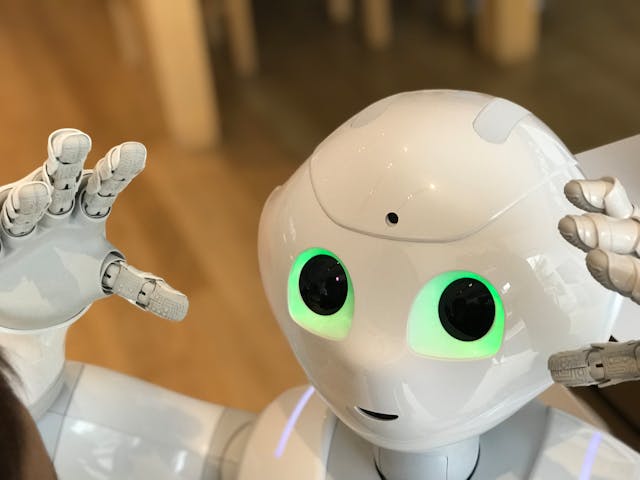
Cognitive Robotics: (e.g. humanoid robots)
Cognitive functions normally associated with people or animals: act autonomously to achieve goals and cope with unpredictable situations
Can interpret various kinds of sensor data
Comments Feel free to leave your opinion or questions in the comment section below.
By clicking on 'Sign in with Github', a login cookie is created. You can undo this at any time by clicking 'Delete Cookie'.